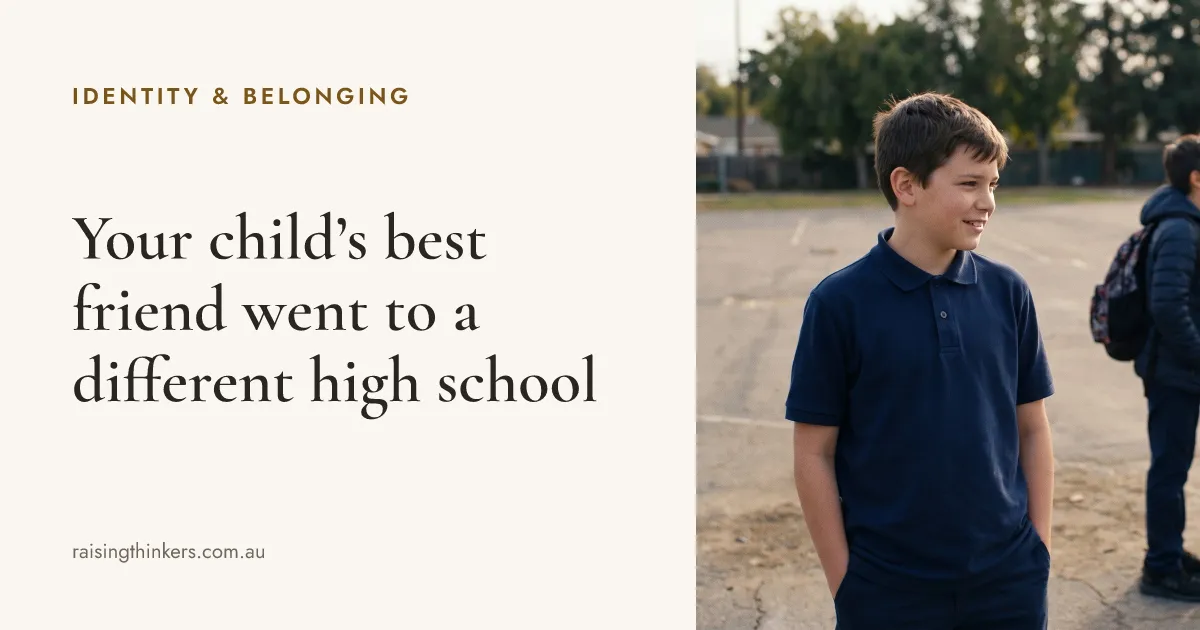
Your child's best friend went to a different high school
The enrolment letters came home three weeks apart. One said Year 7 at your school. The other said Year 7 at a different one entirely.
They spent Year 6 planning it differently. Same building, same locker block, same lunch table on day one. The plan was solid right up until the forms went in.
What this takes from them
In primary school, your child built their identity over six years with a specific group of people around them. Those people held the shared history — who your child was in Year 4, what they were good at, which version of them worked in which room. None of it needed explaining. It just existed.
The best friend was the middle of it. The one who knew all of it.
Now your child walks into Year 7 where nobody knows any of it. They have to explain themselves from scratch, to strangers, every day. And the one person who could have made that easier is in a different building, three suburbs away.
At twelve that is a specific kind of hard to name.
What is actually happening
Most children do not call it grief. They say the friendship is fine, they still text, they will catch up on the weekend. But they come home quieter than expected. The new school comes up less than it should. The old friend comes up constantly.
That is adjustment. They are working out who they are in a new place, without the one person who knew the previous version of them.
Some children rush to fill the gap — a new group fast, holding on to the first people who are friendly. Some go careful and quiet. Both are solving the same problem: who are you when the person who helped you know that is somewhere else?
Where most parents go wrong
The first instinct is practical. You can still see her on weekends. You can still text every day. The friendship does not have to change.
This is kind and it misses the point. The friendship has already changed. Seeing someone every day at school is different from a Sunday visit, no matter how genuine the intention. Pretending the friendship is the same sets your child up to feel like they are doing something wrong when the daily rhythm fades.
The second instinct is to hurry them forward. You will make new friends. It just takes time. Give it a few weeks.
Both skip past the thing that needs naming first: that this is a real loss, and a real adjustment. A child who cannot name it does not move through it faster. They just carry it without language.
A third instinct is to watch from a distance — checking phones, prompting your child to reach out, asking every few days whether they have been in contact. That keeps the friendship as a source of worry rather than a source of comfort. It teaches your child that the gap is something to manage rather than something to live with.
What actually helps
Name it plainly
Not a long conversation. One sentence is enough.
That is a rotten thing, having your best friend at a different school. I know it is not the same.
Just acknowledging it, without trying to fix it, is usually what a child needs first.
Change what the friendship looks like, not whether it exists
The version they had — daily, automatic, already there — is gone. The new version has to be deliberate.
One regular, recurring thing. Not a vague plan to catch up, but something with a specific shape: a Sunday afternoon every fortnight, a Saturday morning walk, a show they both watch. A friendship with a predictable structure tends to last. One that runs on whenever we can manage it often fades in the first term.
Ask about new people by name
Not "have you made any friends yet" — that question has too much riding on it. Instead, ask who they sat with at lunch, or who the funny one in their class is. These have real, manageable answers. When a name starts coming up twice, notice it. That is the thread that might become something.
Look for a bridge
Is there anyone at the new school who already knows your child? A cousin, a teammate from Saturday sport, a neighbour from primary? One person who holds some of the old story makes the new school less completely foreign. If there is someone — even a loose acquaintance — it is worth encouraging that connection in the first weeks.
Give it until the end of first term
Most Year 7s find their people somewhere between week four and the end of term. Before that the social world is still forming. After that it starts to settle. If your child still has no one by the end of first term — no name that comes up, no one to sit with at lunch — a quiet word with the year level coordinator is the right call. Not an alarm, just eyes on it.
The thing to hold onto
The pact they made in Year 6 — same school, same everything — was real when they made it. The fact that it broke is not a verdict on the friendship.
Most adult friendships work exactly like this. You are together every day, and then geography changes things, and you find out whether the friendship is bigger than the proximity. Some are, and some are not. At twelve, that is a hard way to find out.
What your child is learning — how to hold on to something real when the easy version of it is gone — is one of the more useful things a person can learn. It just does not feel useful yet.
The friendship that survives different schools is not the same as the one they had. It is also usually the one they still have at twenty-five.
Getting ready for high school? Our free guide, 9 Things to Sort Out Before High School, covers the nine things parents told us worry them most, with what to say and one thing to try tonight for each. Get the free guide.