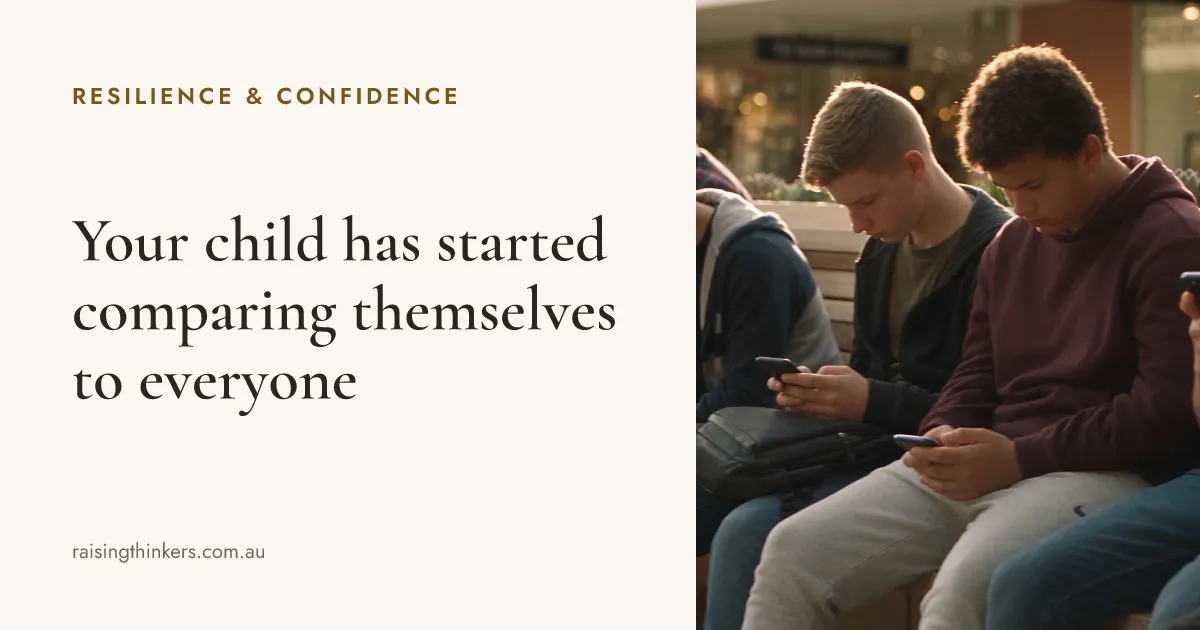
Your child has started comparing themselves to everyone
They never used to mention other children. Now every conversation has a ranking in it. Who is better at maths. Who got picked. Who is faster, funnier, further ahead.
This starts almost exactly when high school does, and there is a structural reason for it.
The field just got visible
In primary school your child was one of maybe thirty. The comparison set was small, familiar, and mostly settled — everyone knew roughly where everyone sat and had made peace with it years ago.
Year 7 replaces thirty with two hundred. Streamed classes make the ranking explicit. Results get compared out loud. Sport is selective. For the first time, a child can see the entire distribution and locate themselves on it precisely.
For a lot of children — particularly the ones who were always near the top of a small pond — that is the first genuinely difficult piece of information they have received about themselves.
Why it hits the capable ones hardest
A child whose identity has quietly been the clever one, or the fast one, has spent six years with evidence that it is true. High school does not disprove it. It just introduces twenty people who are cleverer or faster, and that is enough.
If being good at it is who you are, then not being the best at it is not a disappointing result — it is a threat to the self. That is why the response is so often to stop trying rather than to try harder. Withdrawing protects the identity; competing risks it.
Where most parents go wrong
Denying the comparison. You are just as good as them. It is not a competition. Both are kind and both are transparently untrue to a child who can read a results sheet.
Or making it a lesson about effort — they just work harder than you. Sometimes accurate. Rarely useful in the moment, and it lands as blame.
Or joining in. Comparing them favourably to somebody else confirms the whole frame: that worth is a ranking, and today they happen to be higher.
What helps
Agree with the facts, then change the axis
Yeah, she is quicker at maths than you. What are you better at now than you were in Year 6?
Do not argue with something they can see. Move the measurement from other people to their own previous position, which is the only comparison that is both true and useful.
Make the improvement visible
Children are terrible at noticing their own progress — it happens too slowly and they are standing too close. Say it out loud. That essay is better structured than the one in February. You could not do that in Year 5.
The child who can see themselves improving has something to hold that does not depend on anybody else's result.
Name what it costs to be good at something
The talented ones in any room are usually training. Saying that plainly reframes the gap as a thing built rather than a thing owned — which puts it back within reach.
Be careful what you praise at home
If the family currency is marks and placings, comparison is the natural consequence. If it is effort, recovery and interest, there is at least a second scoreboard available.
What comparison is actually for
It is not a fault. Working out where you sit among others is how humans calibrate, and children who never do it struggle later in different ways.
The problem is not that your child compares. It is that at twelve they have only one axis to do it on, and it is always relative to other people. Adding a second axis — themselves, over time — is most of the work.
When to look closer
Worth attention if the comparison has become constant self-criticism, if they have stopped trying at things they used to enjoy, if it extends to how they look and talk about their body, or if it is still escalating in the second half of the year rather than settling.
Ordinary comparison is noisy and eases. Comparison that has turned into a verdict about themselves is worth another set of eyes.
Getting ready for high school? Our free guide, 9 Things to Sort Out Before High School, covers the nine things parents told us worry them most, with what to say and one thing to try tonight for each. Get the free guide.