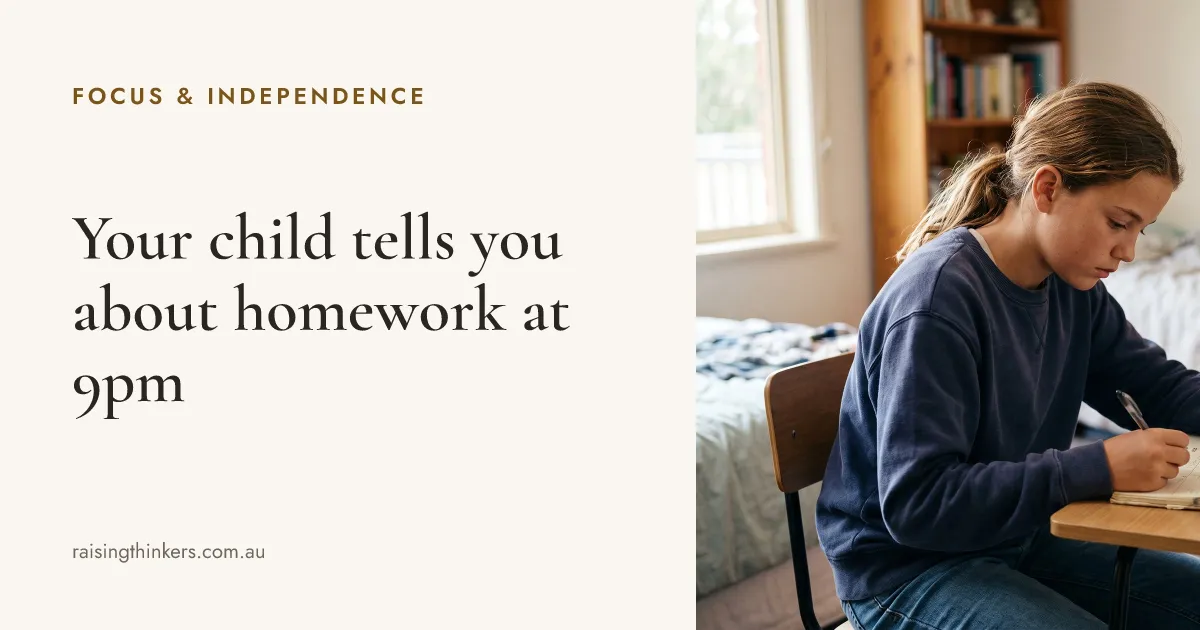
Your child tells you about homework at 9pm
The routine goes like this. Dinner is done. You are thinking about the evening winding down. Then your child appears in the doorway: Mum, I have a project due tomorrow. I forgot to tell you.
Sometimes it is a permission form at the bottom of a bag. Sometimes it is a maths task that was set on Monday and is due first period tomorrow. Sometimes there is a test, and they only just remembered it exists.
This is one of the most common Year 7 patterns there is. It is also almost entirely predictable, once you understand why it happens.
Why Year 7 brings it
In primary school, homework ran on a visible cycle. Set Monday, due Friday. One teacher, one classroom, one predictable pattern. Your child did not need to track it. The structure tracked it for them.
Year 7 removes that structure on day one. Eight teachers. Eight different expectations for how work gets recorded, when it is due, and how much notice gets given. Some of it is written on the board. Some of it is announced aloud while students are already packing their bags. Some of it lives on an app the school uses, which your child has not quite worked out how to check yet.
On top of that, the part of the brain that handles forward planning — knowing what is coming and acting before it arrives — is still developing in teenagers. It does not fully mature until the mid-twenties. Asking a twelve-year-old to hold a week's worth of obligations in their head and act on them early is genuinely hard, in a biological sense, not a motivation sense.
So things stay in the bag until the deadline makes them visible.
Where most parents go wrong
The first instinct is to build a system. A shared calendar. A homework board in the kitchen. A nightly check-in where everything gets reviewed together.
All of those can work. The problem with all of them is the same: if you are running the system, your child is not learning to. The Year 9 panic, the Year 11 all-nighter — many of those trace back to a Year 7 parent who solved this too thoroughly. The job of tracking never got handed over, because it never had to be.
The opposite instinct — drop them in and let natural consequences teach — sounds principled but often does not work either. A child who panics alone at 9pm with no skills and no plan does not build organisation from the experience. They build dread, and learn that school is a place where things go wrong without warning.
What helps instead
Move the check to the morning, not the evening
Ask one question before they leave for school: What have you got on today?
That question is different from have you done your homework. It asks them to open the diary and look forward, not to report backwards. And it happens at the right moment — when they are still in the house and can actually do something about what they find.
Most of the 9pm discoveries would surface here instead, at a time when there is still a day ahead of them rather than a night behind it.
Do the Sunday look-ahead, briefly
Ten minutes, at the kitchen table, before the week starts. You are not checking homework. You are sitting beside them while they look at the planner and name what is coming this week.
What has a deadline. Which day has a big piece due. Whether anything needs to be started before the night before it is due.
The point is not the planning. The point is that they are looking at their own week while you are there. That habit, built slowly across a term, is worth more than any system you could set up for them.
Give them one question of their own
Not a lecture about organisation. One phrase they can use themselves: Is anything due tomorrow?
Ask it at dinner. Prompt them to ask it themselves when homework is done. Put it on a piece of paper inside the bag if that helps. The idea is for it to become automatic — the last thing that happens before the bag is packed rather than the first thing that gets skipped.
Let one small miss happen on purpose
Choose something low-stakes in the first term and let the consequence land. A missing worksheet. A piece of homework not done. The teacher's response — a note, a lunchtime catch-up, staying back — is something your child survives. And surviving it changes the calculation: the consequence was real, it was manageable, and it was connected directly to something they could have controlled.
That lesson is more durable than any reminder you can give.
When you are already in the 9pm crisis
Help them, briefly. Not by doing the task. By helping them break it into pieces and work out what the first step is. How long each part might take. What can be done tonight and what would need an extension.
Sit with them long enough for them to have a plan, then leave them with it.
Later — not that night, when everyone is tired — ask one question: What is one thing that would have meant you knew earlier? Not a lecture. One question. The answer they come up with themselves is the one they will actually use.
The bigger picture
The 9pm announcement is a symptom. The problem behind it is that your child has never had to track their own obligations before, because the school structure always did it for them.
That skill takes a year to build. It does not arrive after one conversation or one good week with a planner. It comes from the Sunday ten minutes, repeated across a term. From the morning question, asked again and again until it becomes automatic. From the occasional missed thing that turned out to be survivable.
Your job is to stay close enough to catch the big ones while letting the small ones teach. That is not a small task. But it is what handing independence over actually looks like, one week at a time.
Getting ready for high school? Our free guide, 9 Things to Sort Out Before High School, covers the nine things parents told us worry them most, with what to say and one thing to try tonight for each. Get the free guide.