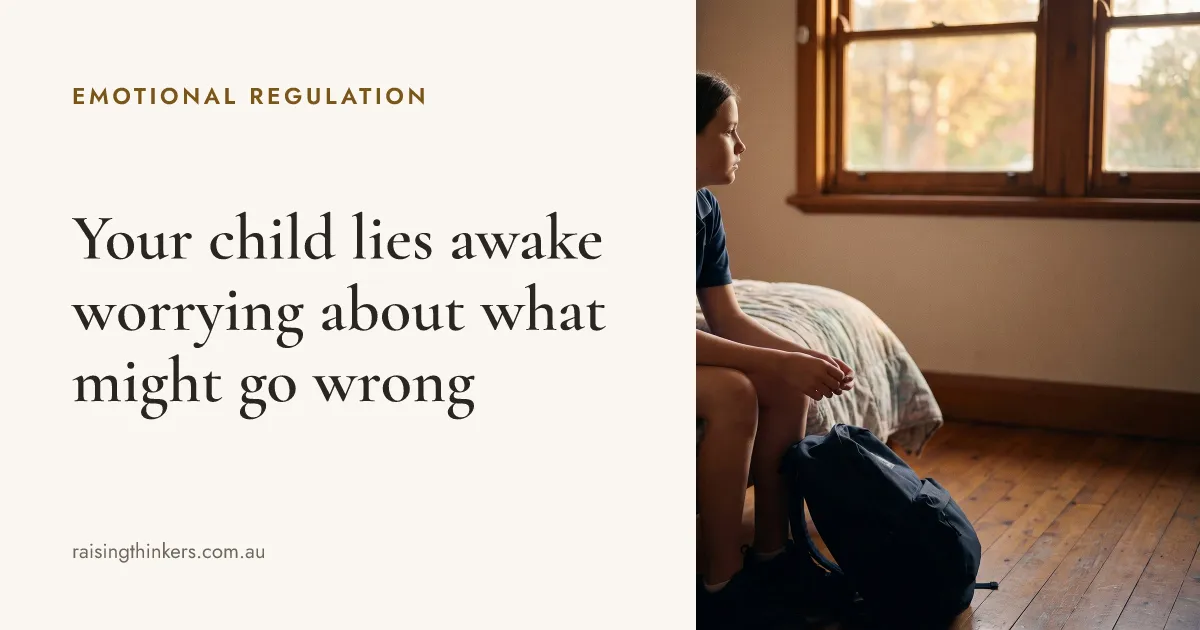
Your child lies awake worrying about what might go wrong
Lights out at a reasonable time. Twenty minutes later, the door opens.
What if I forget the locker combination. What if I miss the bus. What if the teacher asks me something and I get it wrong in front of everyone.
You answer each one. Another arrives. You answer that. The list does not get shorter — it moves sideways.
What is actually happening
Worry about things that have not happened yet is very common at twelve. It is not a character flaw and it is not a sign of something broken. But it does spike at the transition to high school, and there is a structural reason for that.
Your child knows the rules of primary school. They have been there six years. The rooms, the teachers, the patterns — all of it was automatic. They could move through the day without thinking much about what came next.
Year 7 is not automatic yet. Every day involves small calculations. Which building is period four in. What this teacher expects when you hand work in. Where you sit at lunch if your usual group is not there. The brain that used to coast through the day is now working hard, and some children respond to that by running worst-case scenarios through the night so they have a plan for everything that might come up.
If something bad might happen tomorrow, they want to have already prepared for it. That logic makes sense at twelve. The problem is just that the dial which says enough, we are prepared is not yet working reliably.
Why it lands at some children more than others
It is more common in children who have always thought carefully before acting, who notice things others walk past, and who care a lot about getting things right. Those traits are not problems. They just make the night-time brain busier than it needs to be.
It is also more common in children who had a very smooth primary school experience. A child who never really struggled through Years 3 to 6 has very little evidence about what happens when things go wrong at school. Without that evidence, the brain fills the gap with worst-case, because worst-case is the only thing it has not yet seen disproved.
Where most parents go wrong
The first instinct is to answer each question. The combination is in your phone. You have three buses you can catch. Nobody will think it is stupid. Each answer lands well for about ninety seconds before the next question arrives.
What you have accidentally taught the brain is this: bringing a worry to a parent is the thing that settles it. So the brain brings more worries. You have built a machine you did not mean to build.
The second instinct is to correct the thinking. That is extremely unlikely to happen. You are worrying about nothing. Worst case, you can ask the teacher. All accurate. None of it lands at eleven at night when the worried part of the brain is running the show. Reasoning does not reach it at that point.
The third instinct is to stay until they settle — sitting nearby, reassuring them, waiting for the calm before you leave. This often works in the short term. In the medium term it teaches your child that they need an adult present to put the worry down. That is not the skill you want to build. They need to be able to do it themselves, at camp, at a friend's house, at fifteen.
What helps instead
Name what the brain is doing
Do this in the daytime — not at eleven at night when it is already happening. Explain it without drama.
Your brain is very good at planning ahead. Sometimes it does that when it is supposed to be resting, and it starts running through everything that might need a plan. That is what the what-ifs are. The brain is not wrong to do it — it just does not know when to stop.
This de-shames the worry. And it gives your child something to call the experience that is not I am a nervous person or something is wrong with me.
Create a worry time before bed
Not at the moment bedtime starts — ten minutes before. Sit down together briefly. What is on your mind tonight. Say the whole list. Write it down if that helps.
Then close it. The worries have been named. They are going nowhere. Bedtime is a separate thing now.
This sounds simple. For many families it changes bedtime significantly. A brain that has been given an official time to worry is less likely to invent its own at midnight.
Teach one physical tool instead of more words
By the time the spiral has started at night, words are not very useful. The thinking part of the brain has handed over to the feeling part, and the feeling part does not respond well to arguments. What reaches it is physical.
Slow breathing helps. In for four counts, out for six or seven. That is long enough to start slowing the heart rate, which settles things faster than any answer you can give.
Teach it in the daytime, when they are calm. Practise it when there is nothing worrying happening. At night, the prompt becomes just: use your breathing. Not a conversation. One reminder.
Give them a short phrase to use
Something they can say to themselves works well:
That's the brain planning again. I know. We can do that tomorrow. Sleeping now.
It sounds small. It works because it acknowledges the thought without arguing with it or engaging with the content. The worried part of them gets a response — it is not being ignored. But the response is not a debate.
It takes practice. A child who has been using something like this for a few weeks finds it lands differently from one trying it for the first time at midnight.
One plan per concrete worry, then it is done
If a worry is specific — the locker combination, the bus route, who to sit with — make one concrete plan together in the afternoon, when both of you are calm. Write it down. Name that this one is now sorted.
If that same worry comes back after the plan has already been made, it is no longer a planning problem. The brain is running a loop, and the breathing and the phrase are the right tools — not another conversation about the same worry.
When to look closer
Worry that spikes in the first term and eases across the year, stays contained to bedtime, and does not affect whether your child goes to school — that is ordinary, and most of it resolves as Year 7 becomes familiar.
Worth more attention if the worry is still building rather than easing by mid-year. Or if it has moved into the body — stomach aches on school mornings, headaches, not wanting to eat before school. Or if it is making them avoid things: saying no to a school activity because something might go wrong. Or if getting out the door has become difficult most days, not just occasionally.
At that point, a conversation with your GP is the right move. Early help for this kind of worry is very effective at this age. The habits are still forming and nothing is entrenched yet.
The thing to hold onto
A child who worries about what might go wrong cares about doing well. They want to get things right, to belong, to handle whatever comes. That drive is not the problem.
The problem is just the off-switch — the part that says enough planning, it is time to rest now. At twelve, that switch is still being built. It gets better with practice and with the right tools.
A child who learns to put a worry down at twelve will know how to do it at twenty-five. That is worth more than any answer to any specific what-if question.
Getting ready for high school? Our free guide, 9 Things to Sort Out Before High School, covers the nine things parents told us worry them most, with what to say and one thing to try tonight for each. Get the free guide.