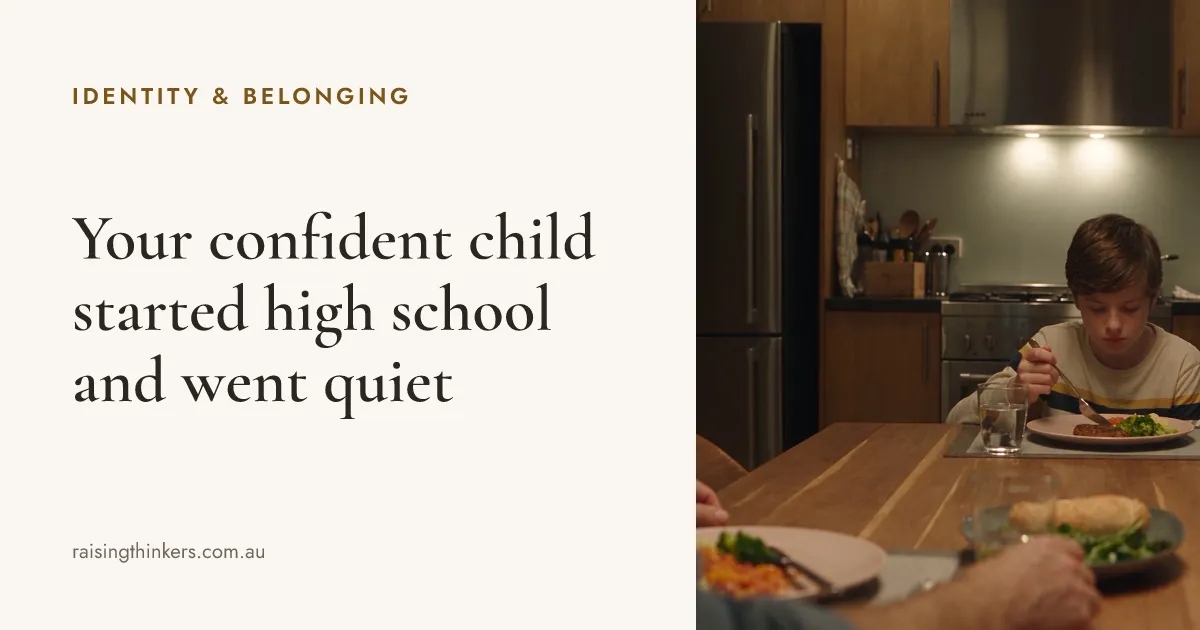
Your confident child started high school and went quiet
In Year 6 they knew everyone. They had a role, a group, a reputation. Teachers knew their name before they said it. They walked into that school like they owned it, because in a small way they did.
Now they come home and say almost nothing, and you are watching a smaller version of your own child.
Confidence does not travel
We talk about confidence as though it is a possession — something a child has, and carries with them. It is not. Most of it is context.
Your child's confidence in Year 6 was built out of six years of accumulated evidence in one building. They knew the rules, the shortcuts, the teachers who would let things slide. They knew where they sat in the pecking order and had made peace with it. Every one of those things was earned, and every one of them stayed behind when they walked out the gate.
In February they start again with none of it. Same child, no evidence.
What is actually happening
Watch a Year 7 in their first term and you are watching somebody run an enormous background calculation. Who is safe. What is funny here. What gets you noticed in the wrong way. Which version of me works in this room.
Going quiet is not a collapse. It is a strategy — and a sensible one. When you do not yet know the rules, saying less is the lowest-risk option. Most children turn the volume down while they work out what this place rewards.
It looks like lost confidence. It is usually data gathering.
Where most parents go wrong
The instinct is to reassure loudly. You are so good at making friends. You will be fine. Remember how popular you were last year.
Every one of those compares the present unfavourably to the past, which is the last thing a struggling child needs. It also quietly communicates that the current version of them is a disappointment.
The other instinct is to solve it — ring the school, arrange a playdate, find them a club. Sometimes useful. But if it happens too early it teaches the child that the discomfort was an emergency rather than a phase, and that they could not have handled it alone.
What helps instead
Ask about the room, not the feelings
Who did you sit with. Who is funny in your class. Which teacher is the strict one. These have real answers, they are low stakes, and they build a picture across weeks that no direct question about happiness ever will.
Notice out loud, without prescribing
You seem a bit flat this week. Makes sense — it is a lot of new all at once.
Naming it without demanding they do something about it is the difference between feeling seen and feeling managed.
Protect one thing they are already good at
Sport, music, the thing they do on a Saturday. In a term where everything is unfamiliar, one place where they are already competent is worth more than any pep talk. This is the moment to guard that commitment, not to let it slide because school is busy.
Give it two terms before you worry
Most children look noticeably more themselves by the middle of the year. The rebuild is slow because it is real — they are constructing new evidence, one small experience at a time.
When to step in
Quiet and watchful is normal. Worth acting if they have no one at all to sit with by the end of first term, if they are avoiding school, if the flatness has spread to weekends and holidays, or if they are talking about themselves in ways that go beyond a bad week.
A quiet child working out a new room is ordinary. A child who has stopped trying to find a place in it is worth a conversation with the school.
The reframe worth holding
They have not lost anything. They have moved somewhere the old evidence does not count, and they are building it again from scratch. That is a genuinely hard thing to do at twelve, and most of them do it without any help at all.
The child you are missing is still in there. They are just busy.
Getting ready for high school? Our free guide, 9 Things to Sort Out Before High School, covers the nine things parents told us worry them most, with what to say and one thing to try tonight for each. Get the free guide.