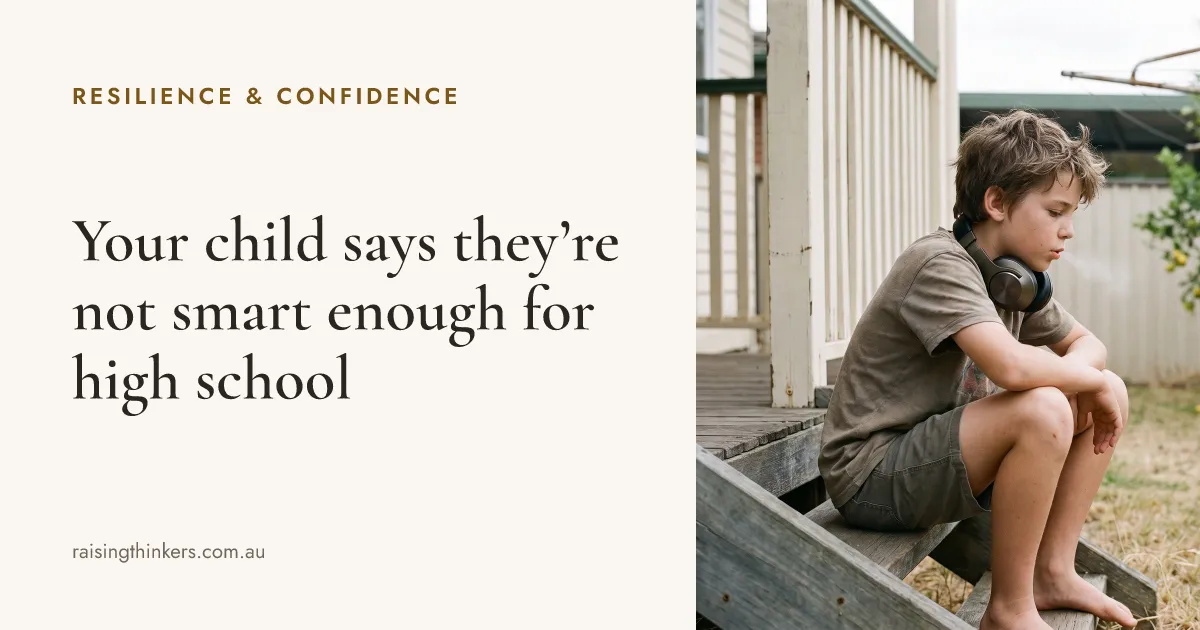
Your child says they're not smart enough for high school
The paper comes home folded at the top. Or the portal updates at 11pm and you see it before they do. Either way, the number is there — lower than you expected, lower than they expected — and by the time you get to talk about it, your child has already decided what it means.
They are dumb. They are bad at science. They are not a maths person and never were. High school is harder than primary school and the gap has finally shown them what they always suspected.
None of those things are true. The mark, however, feels like proof.
Why one bad mark lands so hard in Year 7
In primary school most children had some experience of being wrong, but it was buffered. The class was small. The teacher knew them. A bad result got contextualised — by the adult, by the child's own history with the subject, by the fact that everyone else in the room had seen the good results too.
Year 7 removes the buffer. New school, new classmates, no shared history. A bad mark here is not "she had a rough week" — it is "she doesn't know this." The audience is 200 people who have not yet seen anything go well for her.
And for a child who was near the top of primary school, it arrives as something new: evidence that being clever is not automatic. That is a different kind of hard than a bad mark when you are already used to them.
What children do with that story
There are a few common responses, and all of them are logical from the inside.
The first is globalising. One bad mark in science becomes: I am bad at science. Then: I am bad at school. A twelve-year-old's mind is looking for the rule, and I am not good at this is a clean, simple rule that explains everything and asks nothing further.
The second is opting out. If you have decided you are bad at science, trying hard in science just produces more evidence that you are bad at science. Not trying hard protects you from finding out. It looks like giving up. It is self-preservation.
The third is deflecting blame. A child who is upset about a mark will often make it about the teacher, the marking, the fairness of the question, the fact that the topic was never explained properly. Some of this is accurate. Most of it is the bad feeling looking for somewhere to land that is not them.
Where most parents go wrong
The first instinct is to argue with the verdict. You are smart, you have always been good at maths, one test does not define you. All true. Almost none of it lands, because the mark is sitting on the table and they can read it.
Facts do not shift an identity belief, especially a new one. If anything, insisting they are wrong makes the belief feel more fragile — something that needs defending, rather than something that might not last.
The second instinct is to fix it immediately. A tutor, extra study, a detailed plan for next time. Before the conversation is even finished. That can be useful eventually. Right now it signals that a bad mark is a crisis, and that normal recovery is not possible without adult intervention.
The third instinct is to minimise it. Everyone does badly sometimes. It is just Year 7. There are so many more marks to come. Also true. Also not what a child who is already telling themselves they are not clever wants to hear from the adult who is supposed to know them best.
What actually helps
Accept the mark before you do anything else
Not as a verdict. As a fact.
That is lower than you were hoping for. That is a rough one.
One sentence that says: I see it, I am not pretending it is fine, and I am not panicking. That is not a crisis. That is a calibration.
Separate the mark from the story
The mark is information. The story — "I am dumb", "I am not a maths person" — is an interpretation your child has added, and it is the interpretation doing the damage, not the number.
The mark says you got those questions wrong on that day. It does not say anything else yet.
Leave it there for now. You are not telling them they are fine. You are just declining to agree that one result is a verdict.
Ask about the doing, not the getting
Most children cannot tell you where a mark went without looking at the paper together. Walk through it with them — what they understood, where they got stuck, whether there was a gap in the content or a gap in the time they had. You are gathering information, not delivering a judgment.
Name what is already there
You got that whole section right. You could not have done that in Year 5.
Not a participation ribbon. A specific, true thing from the paper in front of you. Children at this age are bad at holding their own progress — they see the gap, not the ground they are already standing on. Naming it out loud, concretely, is part of the job.
Wait before you call the tutor
Give it a week. Watch what they do with the paper. One bad result, followed by a child who looks back at what went wrong, is a resilience story in the making. Two bad results in the same subject, or a pattern across several subjects, is a different conversation. Most parents intervene during the first event, before the child actually needs it.
When to look closer
One bad mark in Year 7, even in a strong subject, is not unusual. Assessments are harder, the format may be unfamiliar, the content may be new.
Worth more attention if the same subject is struggling across several tasks and not just one. Or if your child has stopped engaging with the subject altogether — not just this assessment. Or if they cannot identify a single thing they understood on the paper. Or if the bad mark has been followed by a decision to stop trying.
At that point, a quiet conversation with the teacher is the right move — not to challenge the mark, but to find out what they are seeing. Year 7 teachers are not surprised by a struggling student. They are usually surprised when a parent comes in asking rather than complaining. One conversation, early, tends to go much further than three at the end of term.
The thing to hold onto
A child who brings home a bad mark and tells you about it is still trusting you with the hard things. That is not nothing at twelve.
The story they are telling themselves about that mark is temporary. How you respond in the next few days is part of what makes it temporary, or not. You do not need the right words. You need to stay in the room without treating it like a disaster — and that is usually enough.
Getting ready for high school? Our free guide, 9 Things to Sort Out Before High School, covers the nine things parents told us worry them most, with what to say and one thing to try tonight for each. Get the free guide.