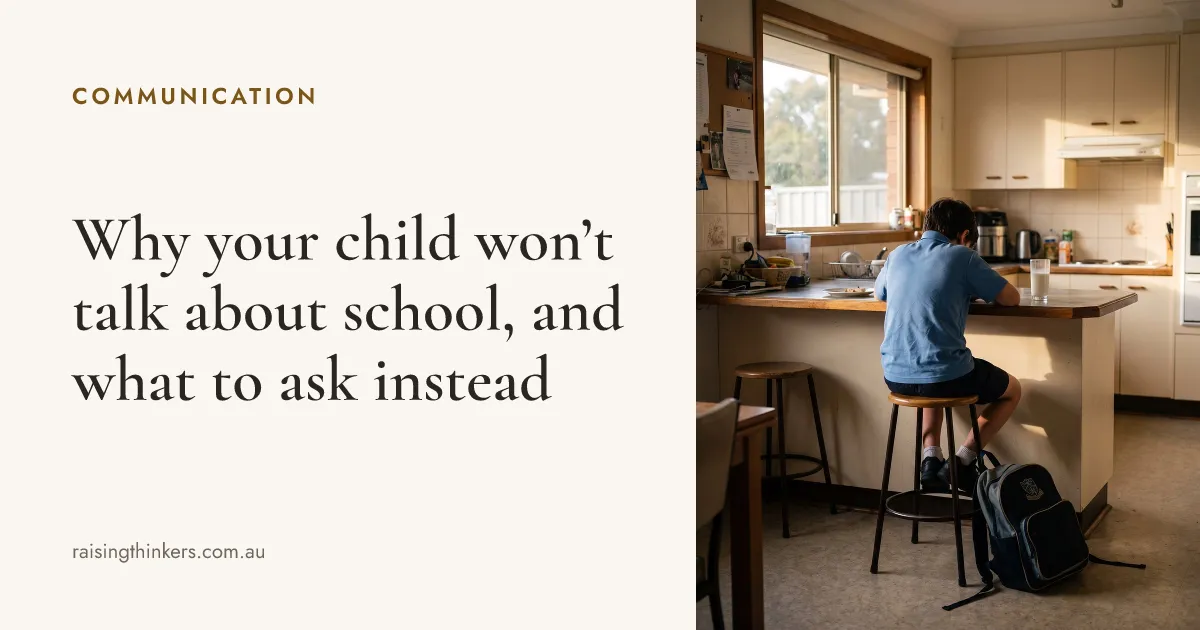
Why your child won't talk about school — and what to ask instead
They walk in, drop the bag by the door, and go straight to their room. You ask how school was. You get fine. You ask if anything happened. You get a shrug. Six months ago this was a child who told you everything, including the parts you didn't need to know.
Nothing has gone wrong. This is the transition doing exactly what it does.
The door doesn't slam shut. It closes one “fine” at a time
Parents tend to expect the moment when a child stops talking — a fight, a slammed door, an obvious break. It rarely arrives like that. What actually happens is a slow narrowing. The answers get shorter. The detail drops away. The stories about who said what at lunch stop coming, and you don't notice the last one until weeks later.
There is a reason it happens now. In primary school your child had one teacher, one room, one group of friends, and a day you could picture. In Year 7 they have eight teachers, a timetable, a building four times the size, and a social world that reshuffles every fortnight. When you ask how their day was, you are asking them to summarise something they have not made sense of themselves yet.
So they say fine. Not to shut you out. Because fine is genuinely easier than the truth, and the truth would take twenty minutes they don't have the words for.
Where most parents go wrong
The instinct is to ask more. More questions, more often, more directly. It feels like care, and to a twelve-year-old it lands as an interview.
Most parent-and-tween conversation falls into four types, and the balance between them tells you more about the state of the door than anything your child says.
1. Logistics — about a fifth of it
We leave at quarter to. Have you packed your bag. Where's your water bottle. These are fine. They're functional, they're necessary, and they are not the place for anything emotional. Keep them short, neutral and warm — and don't try to make them carry more than they can.
2. The interview — about sixty per cent of it
You ask, they answer. You ask, they shrug. You ask again, they leave the room. If most of your conversation is interview-shaped, that is the door closing. Not because the questions are bad, but because the shape is wrong.
3. Side by side — about fifteen per cent, and the part worth growing
These happen while you're doing something else. Driving. Cooking. Walking the dog. Watching something together. Eye contact is broken, the pressure is off, and the talking comes out of the activity rather than out of your asking for it.
This is the ground real disclosure happens on. Almost nothing important gets said across a table.
4. The conversation they start — about five per cent, and the whole game
The one where they come and find you. Where they say can I ask you something. Right now it might happen once a month. Build the third type properly and by Year 8 it happens two or three times a week — and that is where the real story of their life gets told.
Everything else is in service of that one.
The Debrief Walk
The most useful thing a parent can build in these years is a weekly walk. Twenty to thirty minutes, same time each week if possible. No phones. No siblings. No agenda.
The walk is not a conversation. The walk is a container. You walk side by side, you comment on the dog and the neighbour's garden, and you do not ask about school. You just walk.
Somewhere around the fifteen-minute mark, often the tenth, they say something. Not always. But often. It might be small — that girl I told you about did something weird at lunch. It might be enormous — do you ever feel like you're not as smart as everyone else? It might arrive sideways — is it normal to not really want a birthday party this year?
Whatever it is, it is something that would not have been said in any other setting. The walk gave them the room.
The mechanism is well documented. Movement, no eye contact, a repeating rhythm and unstructured time together make up one of the most disclosure-friendly conditions there is. Therapists call it walk and talk. Calling it a debrief helps, because the word sounds technical and unthreatening — which is exactly what a twelve-year-old needs it to sound like.
If you take one thing from this, take the walk.
The questions that actually work
Once you're side by side, the questions that get answers look different from the ones we reach for.
These ones don't work:
- How was your day?
- Did you have fun?
- Did anything happen?
They all ask for a summary or an evaluation, and both are more work than a tired child will do.
These ones do work:
- Who did you sit with at lunch?
- What was the most boring thing that happened today?
- Did anyone say anything funny?
- What's the worst part of maths this term?
- Has anyone done anything weird this week?
The principle is the same in each: ask for one small, specific, observable thing. Not a summary. Not a verdict. One fact.
Every one of those has a real answer. Sophie. Art with Mrs P. No one. Sport. None of it is a deep disclosure. But they are true things — and once a true thing has been said out loud, the next one comes far more easily.
You are not mining them for information. You are building a habit of small, low-stakes honesty. Over a few weeks, the habit gets deeper on its own.
Try this one tonight
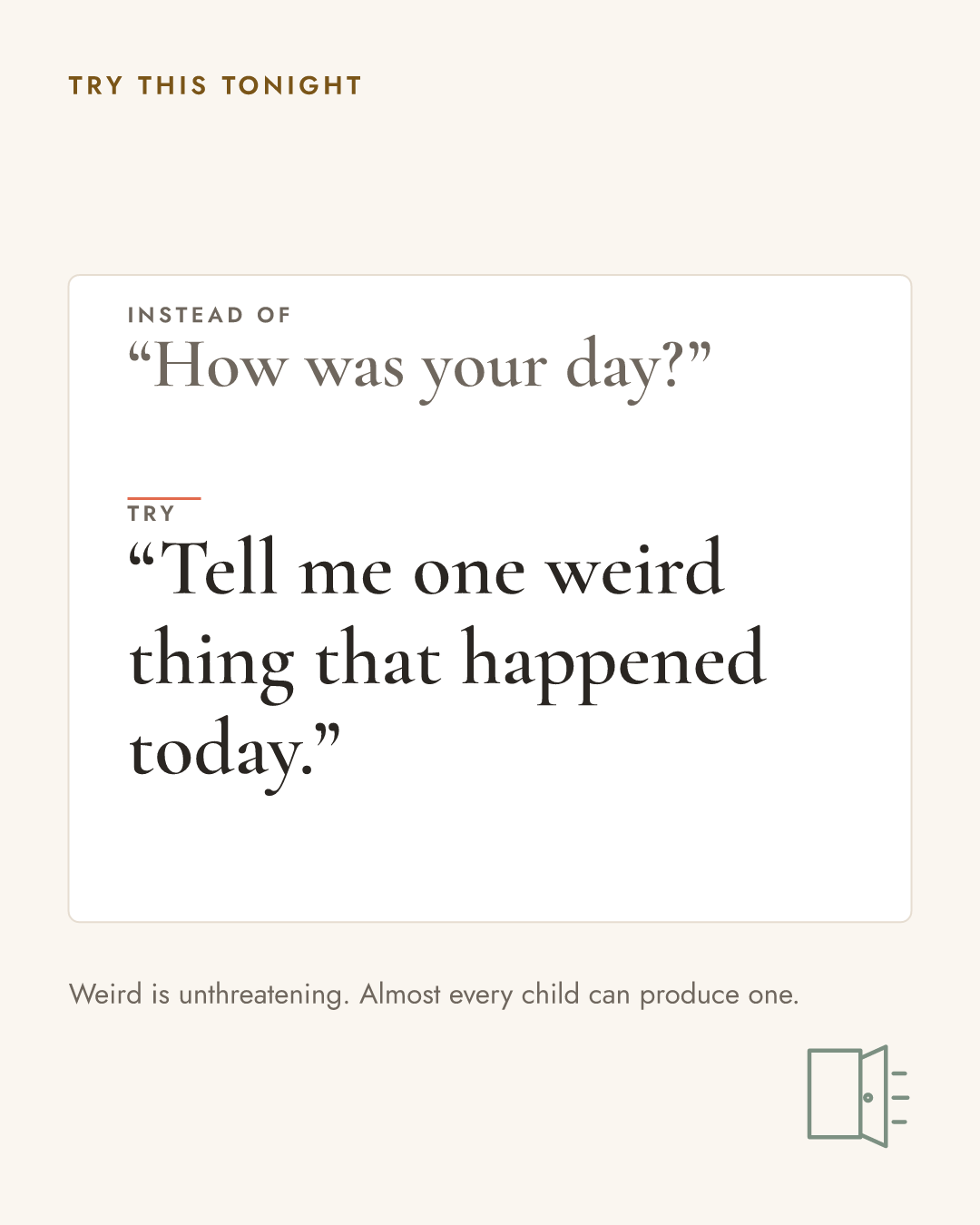
Instead of how was your day:
Tell me one weird thing that happened today.
Weird is doing the work. It isn't asking for good, which sounds like a school report. It isn't asking for bad, which sounds like an invitation to complain. It asks for one specific, observable, ideally funny detail — and almost every child can produce one of those.
Use it every day for two weeks. By the third week, most children start offering the weird thing before they're asked.
The window is now
The years between Year 6 and Year 8 are when these habits set. It is genuinely easier to keep a door open than to reopen one, and the difference between a child who talks to you at fifteen and one who doesn't is usually built quietly, now, in cars and kitchens and on walks around the block.
Start with the weird thing tonight. Put the walk in the calendar for the weekend.
Not sure whether your child is ready for what's coming? Our free guide, 5 Signs Your Child Isn't Ready for High School, walks through the five things that matter most before Year 7 — and what to do about each one. Get the free guide.