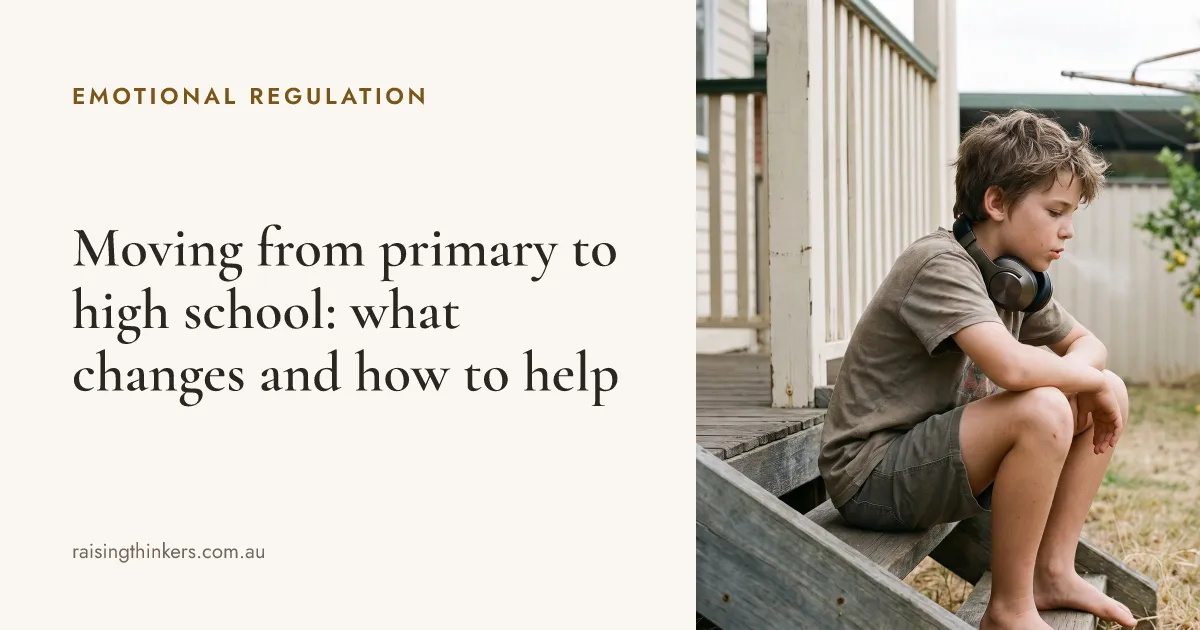
Moving from primary to high school: what changes for your child, and how to help
If your child is transitioning from primary to high school this year — or has just started Year 7 — you are probably wondering what the change actually means for them day to day. Not the orientation-day version. The real one, six weeks in.
Here is what shifts when a child moves from primary school into high school, and what you can do to help them through it.
The school itself is bigger than it looks in the brochure
Primary school was a building your child could draw from memory. They knew where every classroom was, who was in charge of what, and what happened if something went wrong. That knowledge took years to build — and it all stayed behind on the last day of Year 6.
High school is four times the size. Some are bigger. In the first two weeks, your child is finding bathrooms, working out which staircase goes where, and trying not to look lost in front of people they have never met. Just getting to the right room on time is a job in itself.
That gets easier. But for the first fortnight, the building alone takes real effort.
Eight teachers instead of one
In primary school, one teacher knew your child — their moods, their strong points, when something was off. That relationship was a safety net, even when they did not know they were using it.
Year 7 has eight teachers. Sometimes more. Each one sees your child for about fifty minutes a week. None of them has the full picture yet.
Your child has to learn eight different sets of rules — eight different personalities, eight different ideas about what counts as rude and what is fine. Some children find this freeing. A fresh start in every room. Others find it exhausting. Both reactions are completely normal.
The social map disappears
In Year 6, your child had a social map they had been building for years. They knew who was safe, where they sat in every room, and how to read the room. That map took six years to build.
In Year 7, it is gone. Friends from primary school may end up in different classes, or different friendship groups, or just growing in a different direction. New people arrive from schools they have never heard of. Everyone is working out where they fit, all at once.
This is the part most parents underestimate. The academic load of Year 7 is usually manageable. The social load — finding your place in a building full of strangers — is what costs the most energy.
What you will probably see at home
Most children come home flat in the first term. Not upset, not angry — just empty. They have used everything they had, and there is nothing left for the debrief you were hoping for.
You may notice:
- Short answers, or no answers at all
- Irritability the moment they are through the door
- More tiredness than usual — or trouble sleeping
- A drop in confidence, even in things they were already good at
- Resistance to talking about school
None of these means something is wrong. They are signs of a child who is working very hard in a place that is not yet familiar. The flat tiredness usually lifts between weeks four and eight. The Sunday-night dread becomes more occasional. They start to tell you small things — a funny comment someone made, a teacher who is strict, what the canteen is like on a Friday.
What helps during the transition
Give them the first half hour back
No questions, no tasks, food where they can reach it. The conversation that is possible at seven o'clock does not happen at half past three — because there is nothing left. Hold back the urge to debrief at the door. Let them recover first.
Ask about the room, not their feelings
Who is the funny one in your class. Which teacher is the strict one. What did you have for lunch. These questions have real answers, they are not threatening, and they tell you far more across ten weeks than any direct question about whether they are okay.
What is something annoying about your locker?
A complaint is a door opening. Walk through it.
Keep the one thing they are already good at
Whatever they were doing before high school — sport, music, a Saturday activity — protect it now. In a term where nothing is familiar, one place where they are already competent is worth more than a dozen pep talks. This is not the term to drop it because school is busy.
Solve the practical problems out loud
A lot of first-term worry is about not knowing how things work, not about belonging. What happens if I miss the bus. Who do I ask if I feel sick. Where is the canteen.
Walk through the logistics together. Not to manage them — to prepare them. Every answered practical question frees up mental space that was being used to worry about it.
One friendly face is enough
Your child does not need a group right now. In the first term, one person to sit with at lunch is the whole goal. It does not need to be a close friend. Just someone who is not hostile.
If they have that, they are doing fine — even if they do not feel like they are.
When to pay closer attention
Most children settle across the first two terms. The flatness eases. The dread becomes occasional. They find their footing.
Worth paying closer attention if:
- They are still avoiding school or finding reasons not to go by week six or seven
- They have no one to sit with by the end of first term
- The flatness is spilling into weekends and holidays, not just school nights
- They are saying things about themselves that go further than tired — "nobody likes me", "I hate it there", "I'm no good at anything"
Any of those is worth a conversation with the school. The year-level coordinator is the right person — not to escalate, but to give them a fuller picture of what you are seeing at home.
The part worth remembering
The transition from primary school to high school is the biggest change in your child's social and emotional life since they first started school. It takes longer than a week. It takes longer than a term.
The children who get through it well are not the ones whose parents fixed everything. They are the ones who had somewhere safe to come home to, and who were given just enough to get through the next day.
That is your job right now. Not to make it easy. Just to make home reliable.
Getting ready for high school? Our free guide, 9 Things to Sort Out Before High School, covers the nine things parents told us worry them most, with what to say and one thing to try tonight for each. Get the free guide.